
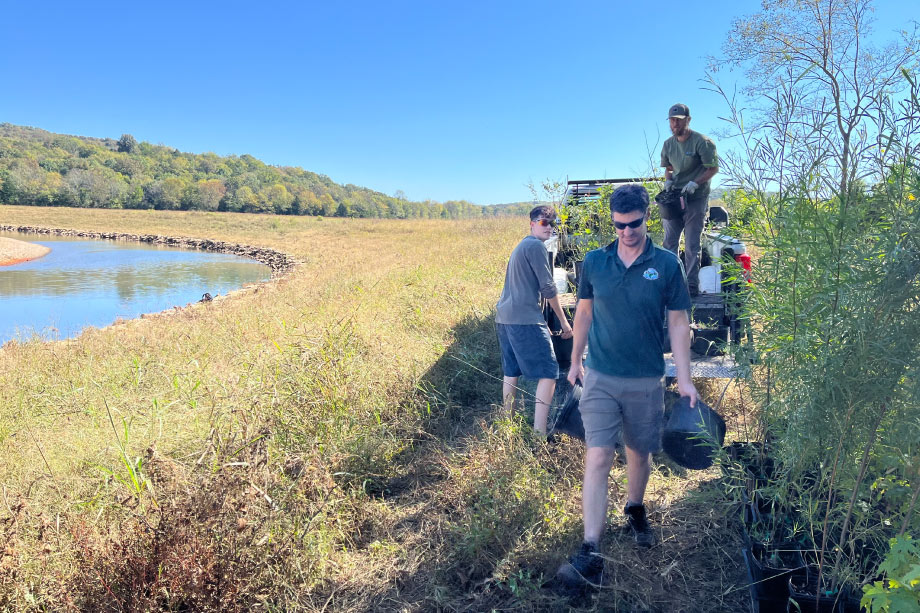
This fall, Beaver Water District began to see the fruits of its participation in the Arkansas Forestry and Drinking Water Collaborative’s (AFDWC) CommuniTree Program. CommuniTree is a cooperative effort focused on improving riparian corridors within watersheds that supply drinking water to Arkansans. Beaver Water District, Conway Corporation, and Central Arkansas Water have served as host partners, growing thousands of trees that will be distributed through the program.
Through CommuniTree, partners grow bare-root seedlings into potted trees, a process that significantly reduces tree mortality once they are planted in riparian areas. With the help of Beaver Watershed Alliance (BWA) and dedicated volunteers, Beaver Water District started approximately 700 native trees this past spring. Over the course of the growing season, these bare-root seedlings developed into healthy, viable young trees, ready for planting.
On October 15, 2025, Beaver Water District delivered 600 trees to a project site along War Eagle Creek, east of Huntsville. The trees were planted as part of a streambank restoration project led by Beaver Watershed Alliance in partnership with the Arkansas Game and Fish Commission. The project addressed eroded banks and restored riparian habitat along War Eagle Creek. With help from volunteers organized by BWA, the planting effort shows how a relatively small commitment from the District can yield significant benefits for the health of the creek.
The CommuniTree Program is designed to keep costs low for landowners interested in improving riparian areas and floodplains through native tree plantings. Landowners are asked only to provide in-kind contributions, such as labor, tools, or equipment, to support planting efforts. Funding for the program is provided by the Arkansas Department of Agriculture – Forestry Division and AFDWC through the Natural Resources Conservation Service.
The trees grown and planted through CommuniTree serve as a critical last line of defense against runoff and erosion that can carry contaminants and sediment into waterways that supply drinking water. Healthy forests lead to cleaner drinking water for all of Arkansas.